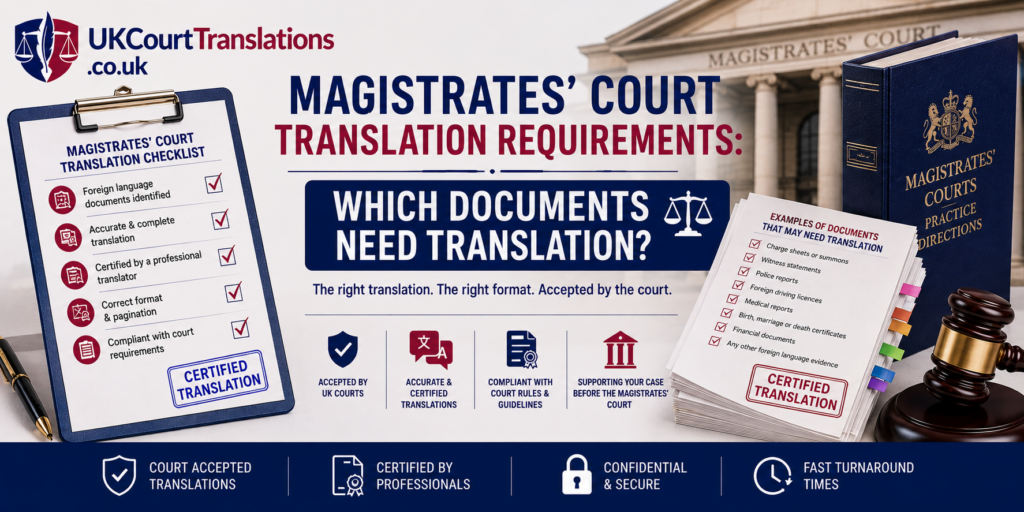
If you’re submitting a legal document that isn’t in English, the UK Magistrates’ Court, your solicitor, or the legal team handling your case may require a certified English translation before the document can be properly considered. The translation should accurately reflect the original document, include the required certification where requested, and be prepared by an experienced legal translator to help avoid unnecessary delays or requests for a replacement translation.
Every year, UK Magistrates’ Courts deal with cases involving foreign-language documents. These can range from police records and witness statements to medical reports, identity documents, financial records, and digital evidence. If the people handling your case cannot understand the original document, an accurate English translation may be needed before it can be properly reviewed.
Preparing documents for court isn’t simply about translating words. The translation must preserve the meaning of the original document, present the information clearly, and meet the expectations of legal professionals involved in the proceedings.
At UK Court Translations, we’ve spent more than 15 years helping solicitors, barristers, investigators, and private clients prepare foreign-language legal documents for UK courts. In this guide, we’ll explain what the Magistrates’ Court may expect, which documents commonly require translation, and how you can prepare them correctly before submission.
Does Every Foreign-Language Document Have To Be Translated?
Not every case requires a certified translation, but if an important legal document is written in another language, there’s a strong possibility that one will be needed.
The requirement usually depends on how the document will be used, not simply on what type of document it is. If it’s being relied upon as evidence or forms part of your case papers, your solicitor or the court may ask for a certified English translation.
You May Need A Certified Translation If Your Document Is:
✔ Written in a language other than English.
✔ Being submitted as evidence in court.
✔ Requested by your solicitor or legal representative.
✔ Important for understanding the facts of your case.
Rather than guessing, it’s always better to confirm the requirement before submitting your documents. Doing so early can save time and reduce the risk of unnecessary delays later in the proceedings.
Good Practice: If your case involves documents from another country, tell your translation provider which court is handling your matter. This helps ensure the translation is prepared for the correct legal purpose.
Which Legal Documents Need Magistrates’ Court Translation?
One of the most common questions we receive is, “Does my document actually need translating?” The answer depends on how the document will be used during the case, but certain documents appear far more frequently in Magistrates’ Court proceedings than others.
| Document | Why It May Need Translation |
|---|---|
| Witness Statements | To help the court and legal representatives understand the witness’s evidence. |
| Police Reports | May support the facts of a criminal investigation or prosecution. |
| Foreign Court Orders | Can provide important background or legal context in some proceedings. |
| Medical Reports | Often explain injuries, treatment, or medical findings relevant to the case. |
| Identity Documents | Help confirm a person’s identity or relationship to the proceedings. |
| Financial Records | May be relied upon in fraud or financial crime cases. |
| Emails & Text Messages | Frequently used as digital evidence where the conversation is relevant. |
| Audio Transcripts | Help present foreign-language conversations in a format that can be reviewed more easily. |
Did You Know? A single case can involve several different document types. Keeping all translations consistent helps avoid confusion when the case papers are reviewed.
What Should A Magistrates’ Court Translation Include?
A court translation should be complete, accurate, and professionally prepared. Missing information or inconsistent details can create unnecessary questions, even when the original document is genuine.
Before Your Translation Is Submitted, Check That It Includes:
- ☑ A complete translation of the original document.
- ☑ Accurate names, dates, addresses, and reference numbers.
- ☑ Consistent legal terminology throughout the document.
- ☑ No missing pages, summaries, or rewritten sections.
- ☑ A Certificate of Translation Accuracy, where certification is required.
- ☑ The translator’s declaration confirming the translation is true and accurate.
These details may seem small, but they play an important role in ensuring the translated document reflects the original as faithfully as possible.
What Can Cause A Translation To Be Questioned?
Most translation issues are preventable. In our experience, problems usually arise because documents are incomplete, difficult to read, or translated without the level of accuracy expected for legal proceedings.
The comparison below highlights the difference.
| ✅ More Likely to Meet Expectations | ❌ May Create Problems |
|---|---|
| Complete translation of every page | Missing pages or partial translations |
| Clear, high-quality colour scans | Blurred, cropped, or unreadable images |
| Certified legal translation | Self-translated or machine-translated documents |
| Accurate names, dates, and reference numbers | Different spellings or incorrect dates |
| Original stamps, signatures, and handwritten notes reflected where appropriate | Missing official markings or unexplained omissions |
Choosing the right translation provider is only one part of the process. Providing complete, high-quality documents from the beginning also helps reduce unnecessary delays and clarification requests.
Remember: Even an excellent translation cannot correct missing pages or unreadable scans. The quality of the original document you provide is just as important as the quality of the translation.
How Should You Prepare Your Documents for Magistrates’ Court Translation?
A high-quality translation starts with high-quality documents. Even the most experienced legal translator can only work with the information that’s visible and complete. Taking a few minutes to prepare your files properly can help avoid unnecessary questions, delays, or requests for replacement copies.
Before Sending Your Documents, Follow These Simple Steps:
1️⃣ Scan Every Page Clearly
Avoid blurred photos or cropped images. If possible, provide colour scans so official stamps, signatures, handwritten notes, and seals remain visible.
2️⃣ Include the Complete Document
Don’t send only the page you think is important. Missing pages can remove valuable context and result in an incomplete translation.
3️⃣ Keep the Original Layout Intact
Avoid editing, highlighting, or covering any part of the document before sending it. The translator should work from the original version whenever possible.
4️⃣ Mention Any Deadlines
If your hearing or submission date is approaching, let your translation provider know in advance so they can advise on turnaround times.
5️⃣ Explain Where the Translation Will Be Used
Telling your provider that the translation is for UK Magistrates’ Court proceedings helps them understand the purpose of the translation and prepare the certification requested for your case.
How We Prepare Documents For Uk Magistrates’ Court Proceedings
Every legal document tells part of a bigger story. Our job isn’t simply to translate words—it’s to ensure the translated document reflects the original accurately, consistently, and professionally.
For more than 15 years, we’ve supported solicitors, barristers, investigators, and private clients with specialist legal translations for UK court proceedings. Every project follows a structured quality process designed for legal documentation.
Our Preparation Process
Step 1 – Document Review
We review your documents to identify the language, document type, readability, and any special legal terminology before translation begins.
⬇️
Step 2 – Specialist Legal Translation
Your documents are translated by experienced legal linguists who understand court terminology and the importance of preserving the original meaning.
⬇️
Step 3 – Independent Quality Check
Every translation is reviewed carefully to check names, dates, numbers, legal terminology, formatting, and overall consistency.
⬇️
Step 4 – Certification
Where required, we provide a Certificate of Translation Accuracy confirming that the English translation is a true and accurate representation of the original document.
⬇️
Step 5 – Secure Delivery
Your completed documents are delivered securely and ready to be shared with your solicitor or legal representative.
This structured approach helps ensure every translation is prepared with the attention to detail expected for legal proceedings.
Frequently Asked Questions
Can I Translate My Own Documents For The Uk Magistrates’ Court?
In many legal matters, a self-translated document may not be appropriate. If an English translation is required, it’s generally advisable to use a professional legal translation provider so the translation accurately reflects the original document.
Can Scanned Copies Be Translated?
Yes. In most cases, clear scanned copies or high-quality photographs are sufficient to begin the translation process. Just make sure every page is complete and easy to read.
Does Every Foreign-Language Document Require A Certified Translation?
Not always. The requirement depends on the role the document plays in your case and any instructions given by your solicitor or the court.
How Long Does Legal Document Translation Take?
Turnaround time depends on the number of documents, their length, the language involved, and your deadline. Urgent requests can often be accommodated where possible.
Can You Translate More Than One Legal Document At The Same Time?
Yes. If your case includes several supporting documents, they can usually be translated together while maintaining consistent terminology across the entire document set.
Need A Certified Translation For The Uk Magistrates’ Court?
If you’re preparing foreign-language legal documents for a UK Magistrates’ Court case, getting the translation right the first time can save valuable time and help avoid unnecessary complications.
At UK Court Translations, we’ve been helping solicitors, barristers, investigators, and private clients with specialist legal translations for more than 15 years. Whether you need a single document translated or a complete bundle of court papers, our team is here to support you with accurate, confidential, and professionally prepared translations.
Ready to get started?
Complete our online enquiry form today to Get a Free Quote. Once we receive your request, we’ll review your documents, explain the most suitable translation option for your case, and provide a fast, no-obligation quotation so you can move forward with confidence.