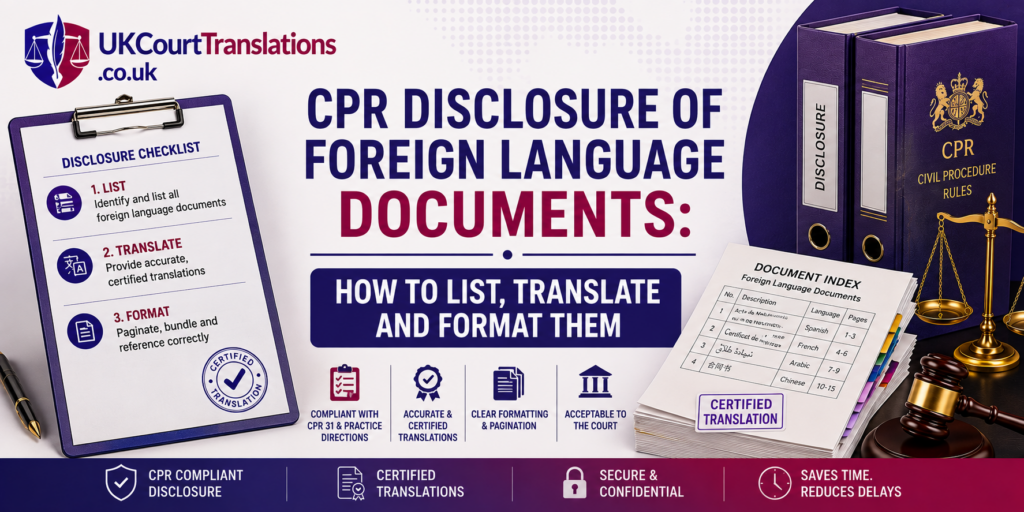
⚡ Quick Answer: In England and Wales, foreign language documents in disclosure do not all need translating — under CPR Part 31 and PD 57AD you disclose documents as they exist, in their original language, and translation becomes mandatory only when a document is relied on in evidence. CPR Practice Direction 32, paragraph 23.2 requires any foreign-language document used in evidence to be translated, with the translator filing a statement verifying the translation and exhibiting both versions. Your List of Documents should identify each document’s original language, and the Disclosure Review Document should record which languages sit in the review population and how they’ll be handled.
If you’re reading this with a disclosure deadline eleven days away and a review population sitting in Mandarin, German and Portuguese, you already know the problem. The rules were written with English-language litigation in mind, and they don’t spell out what happens when a third of your documents sit in a language your reviewers can’t read.
At UK Court Translations we’ve spent fifteen years on the receiving end of that call. What follows is the framework our legal translation experts use with litigation solicitors in the Business and Property Courts — what to translate, what to leave alone, how to list it, and how to format it so nobody can pick it apart at inspection.
Why Multilingual Disclosure Goes Wrong Before Anyone Reads A Document
The costly mistakes almost never happen at the translation stage. They happen weeks earlier, at scoping. Three patterns repeat in cross-border matters. The language spread gets discovered late — a custodian’s mailbox turns out to be 40% Italian, long after the Disclosure Review Document was filed assuming an English-only review. Machine translation gets run across everything to triage relevance, and those outputs quietly start being treated as the disclosed documents. And translation never reaches the costs budget, so a five-figure spend appears from nowhere and the client refuses to authorise it.
What court staff rarely tell you is that none of these are translation problems. They’re disclosure management problems that translation gets blamed for.
What Actually Has To Be Translated — And What Can Stay In Its Original Language
Here’s the distinction that saves the most money: disclosure and reliance are two different obligations.
Disclosure requires you to reveal the existence of documents. Nothing in CPR Part 31 or Practice Direction 57AD requires you to translate a document simply because you’re disclosing it, and inspection is a right to inspect the actual document, in the language it was created in. Translation duties bite later, when a document goes into a witness statement, an exhibit, a skeleton or a trial bundle.
| **Stage of the case** | **Translation required?** | **What’s expected in practice** |
| Initial or Extended Disclosure list | No | List in original language, with an English description of the document type |
| Inspection by the other side | No | Provide the native-language document; they translate at their own cost |
| Relevance and privilege review | No — but you need comprehension | Bilingual reviewers or machine translation for triage only |
| Witness statement exhibits | **Yes** | Certified translation plus translator’s verifying statement (PD 32, para 23.2) |
| Trial bundle and skeletons | **Yes** | Agreed English translation; court guides expect the translator to be identified |
| Expert reports citing foreign documents | **Yes** | Certified translation attached to the report |
⚠️ CRITICAL LEGAL WARNING: Never let a machine-translated output become the version that circulates as “the document”. We’ve seen a triage translation render a supply contract’s liability cap in reverse, and it sat unchallenged for six weeks. Machine translation is a search tool — not disclosure, and not evidence.
How To List Foreign Language Documents So The Other Side Can’T Object
Your list has to let an opponent identify what a document is without reading it. That’s the test.
Step 1 ➔ Run a language audit before you finalise the DRD. Sample each custodian and data source, then record the language breakdown by document count. Languages you fail to declare become a variation application later.
Step 2 ➔ Record the original language as a metadata field. Add a language column to your review platform and populate it during first-pass review. It then flows into your list, privilege log and bundle index without anyone re-touching the documents.
Step 3 ➔ Give every entry an English description. The document stays in Portuguese. The description doesn’t. “Contrato de fornecimento” tells an opponent nothing; “Supply agreement (Portuguese), Alfa Ltda to the First Defendant, 14 March 2021” satisfies the requirement to list documents conveniently and concisely.
Step 4 ➔ Keep original and translation as separate, linked entries. List any translation as its own document with a parent-child relationship to the source. Merging them creates argument about which version was disclosed and when.
Step 5 ➔ State your review methodology, then certify honestly. Set out in the DRD how non-English documents will be reviewed — native-speaker reviewers, translated search terms, or targeted human translation of a sub-set. This matters far more under Model D document-by-document disclosure than under Model B, because the burden scales with every added language. If a language was excluded because nobody could read it, that decision needs justifying before you sign the Disclosure Certificate — not discovering at trial.
Formatting A Certified Translation That Survives Inspection
Once a document has to be relied on, the format of the translation gets scrutinised — not just its accuracy.
A court-admissible translation should mirror the original page for page, reproducing headers, stamps, handwritten annotations and signature blocks as bracketed translator’s notes rather than dropping them. Illegible passages are marked as illegible, never guessed at. Dates convert to DD/MM/YYYY. Company names, case references and party names stay in a fixed form across every document in the matter — inconsistent transliteration of one director’s surname across forty documents is what opposing counsel builds a cross-examination on.
The translation then carries a signed certificate of accuracy naming the translator, their qualifications and the language pair, with a wet-ink or verifiable digital signature. For exhibits, that certificate is supported by the verifying statement required under PD 32. Our specialists deliver this as a single paginated PDF with the certificate at the front, so a clerk isn’t hunting for it.
Two points regularly catch people out. Redactions must be applied to the original and the translation identically and flagged in both — a redaction visible in only one version invites an application. And an apostille is irrelevant here: FCDO apostille legalisation authenticates a foreign public document’s origin, not the accuracy of its English translation. If authenticity is genuinely in issue, that runs alongside your commercial litigation document translation, not instead of it.
Keeping Translation Costs Proportionate And Recoverable
Translation is a disclosure cost, recoverable if reasonable and proportionate. Protect it by making it visible early. Put a translation line in your Precedent H, supported by the language audit from Step 1, and raise it at the CMC while disclosure models are still being argued. A judge who has heard that Model D across four languages carries a defined translation cost is far less likely to treat that spend as disproportionate later.
Then stage the work. Translate only what’s genuinely going into evidence, in tranches as counsel settles the case theory — most matters need certified translation of a fraction of what was disclosed. A standard tranche typically takes 3–10 working days, with expedited handling when a hearing date moves.
Frequently Asked Questions
Do I Have To Translate Documents Just To Disclose Them?
No. Disclosure obligations under CPR Part 31 and PD 57AD attach to the document as it exists, in its original language. The requirement for an English translation arises when you rely on a document in evidence — a witness statement exhibit, an expert report, a skeleton or the trial bundle.
Who Pays For Translating Documents In Disclosure?
The party who wants the translation generally pays. If you’re relying on a foreign-language document, you translate it at your own cost. If your opponent discloses a document in Spanish and you want it in English, that’s your expense — claimable if reasonable and proportionate.
Can I Use Machine Translation For Disclosure Review?
For internal triage and relevance filtering, yes — many multilingual reviews rely on machine translation and translated search terms to narrow the population. It cannot be used for anything that goes on the record. Any document relied on in evidence needs certified human translation with a certificate of accuracy.
What Does The Disclosure Review Document Require About Foreign Languages?
The DRD is where you set out the shape of your review, including data sources, custodians and the approach to non-English material. Identify the languages present and state how those documents will be reviewed and, where necessary, translated. Confirm the current form with the applicable court guide, as these are updated periodically.
How Should A Translated Document Appear In The Disclosure List?
List the original in its native language with an English description of what it is, then list the certified translation as a separate, linked entry showing the date it was produced. That keeps the audit trail clean and avoids argument about which version was disclosed when.
What Happens If The Other Side Challenges A Translation?
Parties are expected to try to agree translations, particularly for the trial bundle. Where one is disputed, the objecting party normally produces its own version and the court resolves the difference. Agreeing translations early is far cheaper than litigating them.
Protect Your Disclosure Deadline With Court-Ready Certified Translations
Since 2009, our certified translators have prepared foreign-language evidence for the Business and Property Courts, the Commercial Court and tribunals across England and Wales, to the certification standards UK courts expect. Every matter is handled by legal translation specialists rather than generalists, under NDA and GDPR-compliant handling. If a certificate or a rendering is ever queried by an opponent or a clerk, our in-house specialists correct it at our own cost, so your submission holds up.
You don’t need a finalised document set to start. Send a sample of your review population — a contract, an email chain, a bundle extract — and our specialists will confirm the languages present, page counts, realistic turnaround against your CMC date and a fixed per-page cost. Request your free disclosure translation quote and you’ll have figures back the same working day, before the deadline works against you.