The message that lands most often at our desks says roughly the same thing every time. We had everything translated. We paid for it. We sent it in. And it’s still sitting there.
One from earlier this year has stayed with our specialists. A Polish will, rendered accurately — every clause right, nothing missing from the English. The letter came back anyway.
Whoever did the work had signed the certification. They had not printed their name anywhere, and there was no address, no email, no way of reaching them. The words were faultless. The paperwork holding the words up was not.
Nobody had been careless. The family simply had not been told that this work is assessed as a package, not as a piece of writing.
We are UK Court Translations, and we have prepared certified legal work for UK courts and registries since 2009. When probate is delayed after documents are translated, the cause is almost never the quality of the language. It is one item from a short, repeating list sitting around it.
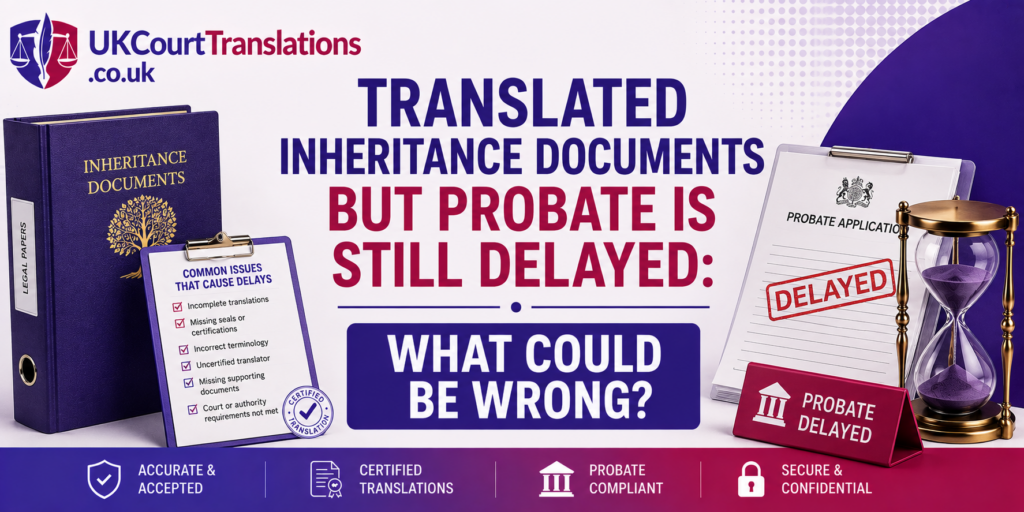
📌 Quick answer: A probate application can still be queried after documents are translated because the service assesses the whole submission, not just the accuracy of the English. The usual causes are a missing or unsigned certificate of accuracy, a translator who is not independent of the estate, pages or reverse sides left out, untranslated stamps and seals, and names appearing differently across documents. Answering every point raised in one complete submission, rather than sending items separately, is what stops the delay repeating.
What A Query Letter From The Probate Service Actually Means
First, some reassurance. This is not a rejection. Your application is alive, it has simply been paused while something is clarified, and in our experience the overwhelming majority resolve without drama.
What it also is not: a comment on your honesty, or a suggestion that the document is fake.
A caseworker reading a file is working through a fixed list. They cannot wave something through because it plainly looks fine, because the decision gets reviewed later and it has to stand up on paper without them there to explain it.
💡 Hold onto that, because it changes how you should reply. You are not arguing a case or defending anybody’s integrity. You are closing a checklist item — and those close quickly when you hand over precisely what was asked for.
Why Accurate English Alone Does Not Get A File Through
This is the thing almost nobody is told at the outset, and it explains nearly every file we are asked to rescue.
A document that gets through has four parts working together:
- The English text itself
- A certificate of accuracy confirming it is complete and true
- A named, contactable person standing behind that certificate
- Everything the original showed — including the parts that are not words
Most families buy the first part and reasonably assume that is the whole product. It is the other three that generate the letters.
➔ It is why a fluent friend’s work fails while an identical standard of English from an independent professional passes. The difference was never the language. It is who is accountable for it, and what travels alongside it.
The Gaps That Get A Translated Estate File Queried
These come up over and over. Most people find their own situation somewhere in this list.
| What went wrong | Why it stops the file |
|---|---|
| No certificate of accuracy attached | Nothing confirms the English is complete |
| Certificate signed but not named | Nobody can be contacted about it |
| Done by a beneficiary or relative | That person gains from the estate, so it is not independent |
| Only the front of each page covered | Reverse sides carry registration entries and stamps |
| Stamps and seals left out | These prove the page is an official instrument |
| A codicil not included | It is a separate document, and quietly easy to miss |
| Names differing across documents | Maiden names, patronymics and passport spellings rarely align |
| Two documents, two providers | One estate reading in two different vocabularies |
Why The Wait Restarts Instead Of Picking Up Where It Stopped
Here is the part that costs families most, and hardly anyone knows it until it has already happened to them.
When you reply, your application does not resume from where it paused. It rejoins the work waiting to be looked at. The weeks you had already served do not carry across.
That one fact rewrites the arithmetic:
- Sending one item now and another next week saves nothing. It costs a full cycle.
- A partial answer that prompts a follow-up costs another.
- Three separate replies can turn a fortnight’s problem into a season.
✔ And the estate is not waiting politely in the meantime. Interest may be running on inheritance tax. A property sale may be sitting behind the grant. Beneficiaries are asking the executor questions the executor has no answer to.
How To Close A Requisition In A Single Response
The most useful thing you can do is refuse to send anything until you can send all of it.
- Read the letter twice and list every separate point. These often contain more than one, and the second is easy to overlook once the first has alarmed you.
- Match each point to its document. Some attach to the will, some to the death certificate, some to an annex nobody realised was a separate item.
- Correct the whole file, not only the flagged part. If one document was handled without its reverse pages, the others almost certainly were too. Fixing just what was mentioned is how people end up with a second letter.
- Attach certification to each document, not to the bundle. Every item should stand on its own if separated.
- Send it as one submission with your reference on every page. A covering note listing each point and where it is answered turns the caseworker’s job into a two-minute one — and over the years we have found that matters more than it sounds.
When A Corrected Submission Comes Back A Second Time
It happens, and it is seldom bad luck.
The usual cause is that the correction introduced something new. Somebody redid the will with a fresh supplier, who spelled a beneficiary’s name differently from the death certificate handled four months earlier. The original problem was solved and a second one was posted in the same envelope.
✔ Which is why an estate is best kept as one file in one place — names, places and defined terms fixed once and applied to everything in it. Not for convenience. So the file reads as one account of one family rather than several strangers describing the same people.
Final Checks Before You Resubmit
✔ Every point in the letter listed and answered
✔ All documents corrected, not only the one flagged
✔ Certification attached per document, signed and naming a contactable person
✔ Application reference on every page
✔ Covering note mapping each point to its answer
✔ Sent as a single submission
Frequently Asked Questions
Can I Chase The Service While My Application Is On Hold?
You can ring the probate helpline for an update, though a case waiting to be looked at again generally cannot be moved up the order. Your time is better spent making sure the reply leaves nothing to come back on.
The Person Who Did The Work Has Stopped Replying To Me. What Now?
That document will need redoing by someone contactable — being able to reach them is part of what the certificate exists for. Send us what you have and we will confirm which items genuinely need it rather than assuming the whole file does.
Does A Query Mean I Have To Pay The Application Fee Again?
No. It pauses an existing application; it does not cancel it. If anyone tells you to reapply from scratch, check directly with the probate service before paying anything further.
My Relative Did It And It Is Genuinely Accurate. Can I Just Explain That?
It rarely resolves anything. The objection is not to the accuracy but to the connection with the estate, and no letter removes that connection. Replacing the document usually costs less than an exchange of correspondence that ends the same way.
We Are Months In Already. Would Starting Again Be Quicker?
Almost never. A paused application keeps its place in the process; a fresh one starts from nothing. Answering properly is nearly always faster — though confirm the position with the probate service or your solicitor before deciding either way.
Let Us Look At The Letter Before You Reply To It
A query is not a verdict. It is a list, and lists close — provided you close all of it at once.
A good deal of our work arrives exactly like this, after somebody else’s version came back. Our specialists have seen most variants of this letter over the years, which usually means we can tell you within a day what is actually wrong rather than leaving you guessing at it.
Send the letter alongside the documents you submitted. We will tell you which items genuinely need redoing, which are fine as they stand, and what belongs in a single reply so you are not opening another envelope in six weeks. Ask us to review your probate query letter and you will have a clear answer, with costs, before anything is committed to.