A file our editors still refer to: an adviser arrived with 214 pages from Iraq. Four languages. Court papers, a party membership card, a lawyer’s letter, three months of newspaper cuttings, a folder of phone screenshots. The disbursement budget covered roughly a fifth of it.
She had already chosen what to translate — sensibly, the dramatic pages. The arrest warrant. The most alarming article. She was going to leave out a dull two-line letter from a local bar association confirming her client’s lawyer had been struck off.
That dull letter was the strongest document in the file, and she nearly binned it.
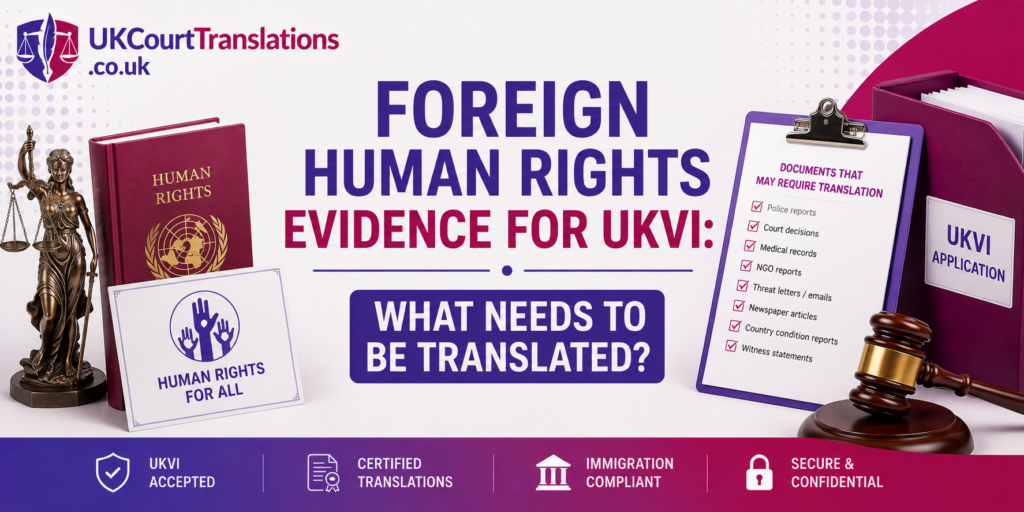
We are UK Court Translations, and we have been preparing legal translations for UK immigration and court proceedings since 2009. Translating foreign human rights evidence for UKVI is not an all-or-nothing exercise, and the instinct to translate whatever reads most powerfully is usually the wrong instinct. Here is the sorting rule we apply, and then how we prepare whatever survives it.
📌 Quick answer: Foreign-language evidence filed with UKVI or the First-tier Tribunal must be accompanied by an English translation, but not every document needs translating in full. Short official documents are translated completely. Long reports and articles may be filed as an extract, provided the translator’s note states the source, the pages translated and what was omitted. An undeclared partial translation causes problems; a declared one does not.
What Home Office Caseworkers Actually Weigh In Supporting Documents
They are not marking your English. In our experience, decision-makers are asking one quieter question: can I tell where this came from, and could I check it if I wanted to?
That question does more work than anything else in the file.
✔ A named source beats a strong claim. A plain letter from a named lawyer carrying a bar reference outranks an anonymous letter describing something terrible.
✔ Checkability is currency. A reference number, a registry, a switchboard, a public record — each adds weight, even if nobody ever picks up the phone.
✔ Corroboration travels in pairs. One document confirming another is worth more than either standing alone.
💡 And a fourth point that quietly governs your budget: a page nobody can read carries nothing. Untranslated material is not held in reserve — it is invisible. Six translated pages that get read will always beat sixty that cannot.
Sorting The Pile: Full Translation, Declared Extract Or Neither
Work through the file once. Every item lands in one of four columns.
| Category | What belongs here | Why |
|---|---|---|
| Translate in full | Arrest warrants, summonses, judicial orders, prison release papers, official IDs, certificates | Short, official, and any clause or stamp can matter. |
| Declared extract | Long country reports, book chapters, investigation files, broadcast transcripts | Only certain passages bear on the claim. |
| Cite, don’t translate | Material already published in English | See the next section. |
| Leave out | Duplicates, unrelated pages, scans with no readable content | Bulk without value dilutes what surrounds it. |
➔ Identity and medical records sit firmly in the first column. Those are short, and every entry can matter, so we render them line by line. Long-form country and third-party material is judged on relevance instead. Applying the identity-document rule to a 180-page report is how a budget disappears before the useful pages are reached.
Country Reports You Should Never Pay To Have Translated
This section regularly removes the single largest item from a quotation — and we would rather remove it than invoice for it.
Major international human rights reporting is published in English as standard. Human Rights Watch, Amnesty International, UNHCR and the US State Department all issue English originals or official English editions. If a local-language copy reached you first, do not commission work on it. Cite the English version and reference the page.
What genuinely needs professional translation:
- Regional newspapers with no English edition
- Domestic NGO and civil society reports published only locally
- Local broadcast and radio material
- Anything issued to your client personally, in their name
📌 One search for an English edition before commissioning anything long. It takes a minute, and over the years it has saved our clients a great deal.
Preparing A Document Properly For An Asylum Or Article 8 Claim
Selection is done. This half decides whether the work holds up. Every stage below exists because we have seen the alternative fail.
- Translate the page, not the paragraph. Letterhead, sender’s name, job title, reference number, address, phone number, stamp, seal, signature block — all of it. This material is what proves where the document came from, and it is the most commonly skipped, because it sits outside the “main text”. Skip it and you have translated the claim while discarding the proof.
- Describe what cannot be reproduced. A round stamp, a wet-ink signature, an embossed seal — described in square brackets exactly where it sits. Say nothing and it reads as an omission.
- Mirror the layout. English beside original, line for line, same order, same breaks. A caseworker should be able to compare without hunting.
- Write the translator’s note first, not last. For an extract: source, pages translated, pages omitted, reason. For a full document: anything illegible. Two or three sentences that pre-empt an entire line of attack.
- Certify with a named, qualified linguist. A signed statement that the work is true and complete, dated, with credentials and contact details. Ours carry a professionally registered translator’s name for exactly this reason.
- Never fill a gap with a guess. Mark illegible text as illegible. A guess that later proves wrong costs far more than the gap ever would.
Keeping Names, Job Titles And Place Spellings Consistent Across Languages
A Kurdish claimant’s file can carry Kurdish, Arabic, Farsi and Turkish at once. Split it between four freelancers and you get four spellings of one name — and an argument about whether the documents describe the same person.
Job titles do quiet damage. Rendering a foreign advocate as “barrister”, or a mukhtar as “mayor”, feels like helping the reader. It is not. Those are English roles carrying English meanings, and they describe something that does not exist in the source country. We keep the original, give a literal rendering, and let a note explain the function.
Place names split a file in half. Sulaymaniyah, Slemani, Suleymaniye — one city. If the country report uses one form and the summons uses another, the link a caseworker needs never forms. Show both, note the variant.
The passport sets the spelling. Whatever the travel document says governs every page. Where an original differs, we record it rather than quietly correcting it.
✔ The fix costs nothing: a glossary agreed before work begins, fixing names, organisations, places, ranks and recurring terms — built once and held across the whole file.
Filing Screenshots And Message Evidence Sent From Abroad
Digital material now appears in most bundles and remains the least consistently prepared item in them.
- Capture the frame, not just the words. Handle, display name, timestamp, date separators, any forwarded marker — all part of the exhibit.
- State the time zone. An unzoned timestamp can slide a message across a date boundary and break a chronology.
- Fix handles once. Non-Latin usernames get one agreed English form, used everywhere.
- Keep threads intact. A single message lifted from a conversation reads as selected. Give the exchange around it.
- Do not enhance. Sharpening or cropping alters an exhibit. File it as captured.
Final Checks Before Your Appeal Bundle Goes To The Tribunal
✔ Every item sorted into one of the four columns
✔ English editions searched for before commissioning anything long
✔ Letterheads, stamps and signature blocks covered
✔ Translator’s note attached to every extract
✔ Certification signed, dated and named
✔ Glossary applied across all languages
✔ Screenshots complete with timestamps and zones
✔ Filed ahead of the deadline, not on it
Questions Advisers And Claimants Put To Us
How Far Ahead Should A Multilingual Bundle Be Commissioned?
Earlier than most people plan for. Volume, language rarity and scan quality all move the timeline, and a four-language file needs a consistency pass that a single document never does. Send it as soon as the scope is known and we will confirm a realistic date before work begins.
Can Evidence Be Handled In Stages As It Arrives From Abroad?
Yes, and in our experience it usually is. We carry the glossary and conventions from the first batch into every later one, so documents arriving weeks apart still read as a single coherent file rather than separate jobs stitched together.
Does Certification Expire?
No. What changes is the underlying document — an entry, a status or a validity date may have moved on. If the original is reissued, the new version needs work; the earlier version remains valid for what it recorded at the time.
Can The Same File Be Used For The Initial Claim And A Later Appeal?
Usually yes, provided nothing in the original has changed. What often needs revisiting is scope rather than accuracy: material that was a declared extract at claim stage may need widening once an appeal focuses on a different issue. Ask us to review the note rather than starting again.
Is It Safe To Send Material Naming People Still At Risk Overseas?
Yes. Files of this kind routinely name people who remain in danger, and we have handled such material for well over a decade. Documents are transferred securely, held under GDPR with signed confidentiality undertakings, and access stays limited to those working on your file.
Send Us The File Before You Commission Anything
Most bundles do not need everything covered. They need the right things done properly, and everything else handled openly. Get that split right and you protect the budget and the case together.
We have sorted files like that 214-page one more times than we can count, for solicitors, OISC-regulated advisers and claimants representing themselves. That conversation costs nothing, and it frequently ends with us recommending less work than the client walked in expecting.
Request a free assessment of your evidence bundle with your filing date attached, and we will come back with the sorting, the certification required and a fixed cost before you commit to a single page.