A man came to us about his mother’s Spanish will. She had retired to Alicante, died there, and left a flat in Spain and a building society account in Leeds. He arrived with an English version already done — by a family friend who spoke fluent Spanish, did it kindly, and charged nothing.
The friend had translated usufructo as “ownership”.
It isn’t. It is the right to live in a property and take its income for life, while somebody else holds the title. His sister was meant to have the flat once their mother’s partner died. On paper, in English, the partner now owned it outright.
Nobody had lied. Nobody had even been careless by ordinary standards. The word has no English twin, and a fluent speaker who is not a legal linguist has no reason to know that.
We are UK Court Translations, and we have prepared certified legal work for UK courts and registries since 2009. Translating international wills for UK probate fails in a small, predictable set of places — and almost never the ones executors brace for. Here is where.
Quick answer: A will written in a foreign language needs an English version before the Probate Registry will consider it. That version must be complete, must reproduce every stamp, seal, notarial number and handwritten amendment, and must carry a signed certificate of accuracy naming the person who produced it. Anyone with an interest in the estate — a beneficiary, an executor, a relative — should not be that person. Whether the original also needs an apostille depends on the country and the document, so confirm before you apply.
What The Probate Registry Checks Before Accepting A Foreign Will
Registry staff are not marking your Spanish, Polish or Arabic. They are asking whether the English in front of them can stand in for the original without anyone having to take it on trust.
✔ Complete, not tidied. Every clause, including the ones that look like boilerplate — revocation wording, appointments, witnessing formalities. Shortened reads as edited.
✔ Independent of the estate. A version produced by someone who stands to inherit can be questioned by anyone who doesn’t. That challenge tends to surface long after the grant, when it is hardest and most expensive to undo.
✔ Named and reachable. A certificate of accuracy carrying a real name, a date and contact details.
✔ Same shape as the original. Clause numbers, page order and marginal notes held in place, so the two can sit side by side.
Here is the part executors rarely anticipate, and the reason our legal linguists treat a will differently from ordinary paperwork. The Registry is not only reading the will — it is reading the instrument. The notary’s protocol number, the register entry, the embossed seal. Those elements prove the document legally exists in its home country. Carry the sentences across, leave the apparatus behind, and you have handed over a text with nothing standing underneath it.
Which Documents Need Translating For A Grant Of Representation
Executors almost always commission too much or too little. This is the split we work through before quoting.
| **Document** | **Position** |
| **The will and any codicil** | Always. A codicil left behind is the single most common omission we see |
| **Foreign death certificate** | Always — the Registry and HMRC both want it |
| **Notarial deed or will register extract** | Yes, where the will is a notarial instrument |
| **Certificate of succession or ECS** | Yes, where one exists |
| **Property deeds, bank statements, valuations** | Usually only the pages showing ownership and value |
| **Correspondence, funeral papers, medical records** | Normally nothing |
➔ Property paperwork is where the money leaks. A forty-page Spanish escritura rarely needs doing end to end when what the Registry and HMRC want is the ownership entry, the parties and the cadastral reference. In our experience most estates arrive expecting a far larger job than the application actually calls for, so ask before you commit to the whole file.
Words In An Overseas Will That Change Who Inherits
This is where things genuinely go wrong, and it is nearly always civil law colliding with common law.
Roles That Look Like A Match And Aren’T
A Spanish albacea, a French exécuteur testamentaire and an English executor overlap — but their powers differ, sometimes sharply. Swapping one for the other flattens a distinction the estate may turn on. We keep the original term, give a literal English rendering, and add a note explaining the function. Over the years, that note has prevented more Registry queries than any other single habit we have.
Ownership That Splits In Ways English Law Doesn’T
Usufruct, nue-propriété, bare ownership, fideicommissary substitution. These separate the right to own from the right to enjoy, and they frequently sit alongside a second beneficiary who inherits only on a death that hasn’t happened yet. Rendered loosely, a future interest reads as a present one — and the estate distributes decades early.
Shares The Testator Was Never Free To Give Away
Many civil law systems reserve a fixed portion for children or a spouse — the légitime, the Pflichtteil, the legítima. A will drafted around those rules reads as nonsense if you assume English testamentary freedom. Our specialists render them exactly, never rationalised into something that sounds more sensible to an English ear.
Names Recorded Differently In Different Countries
A notarial deed may record a woman under her maiden name for life, while her passport shows her married name. Both are correct at source. We fix one form to the identity document and record the variant where the original differs, so the Registry sees one person rather than two.
Handwritten Wills, Faded Seals And Notes In The Margin
Holographic wills — written out by hand by the testator, no notary involved — are perfectly valid across much of Europe and reach UK probate more often than people expect. They are also the hardest documents that cross our desks.
- Unreadable stays unreadable. An illegible word in a will is not a stylistic problem. It may be a name, a sum or a property, and inventing something plausible puts a stranger’s inheritance on a guess.
- Crossings-out stay. Deletions, insertions and initialled amendments are part of the instrument, not mess to be cleaned up.
- Margins get read. A note squeezed down the side of a page can revoke a gift outright.
- Impressions get described. Where a seal cannot be reproduced, it is described in square brackets exactly where it sits.
The Apostille Sequence That Catches Executors Out
The detail that trips people up is where an apostille actually goes. It is not applied to the English translation. It goes on the original foreign document, it is issued abroad in the country the document came from, and it confirms that the seal or signature on that original is genuine.
So the sequence matters more than the choice. An apostille is obtained overseas and can take weeks. If your estate needs one, start it before commissioning any translation work here — and confirm the requirement with the Probate Registry or your solicitor first, because it shifts by country and by document type. Where certification alone is not enough, our notarised translation service covers what the extra step involves.
Getting Estate Papers Ready Before You Send Them To Us
Five things that cut both the timeline and the bill.
- Send both sides of every page. Reverse pages carry notarial entries and registration stamps far more often than people expect, and a missing back page remains our commonest cause of delay.
- Scan flat, in colour, full page. Angled phone photos lose the edges — and the edges are where the seals are.
- Tell us where it’s going. The Probate Registry, HMRC, a Spanish bank and a foreign land registry can each want a different level of certification. Knowing the destination first stops you paying twice.
- List every name the deceased used. Maiden names, patronymics, religious names and anglicised spellings all appear across estate paperwork, and the ones you forget are the ones that surface in a bank’s records.
- Say what’s driving the deadline. An IHT400 date and a family’s own timetable are very different pressures, and we advise differently on each.
Final Checks Before Your Hmcts Probate Application Goes In
✔ Will and codicils covered in full
✔ Death certificate included
✔ Notarial number, register entry and seals all reproduced
✔ Handwritten amendments and marginal notes carried across
✔ Certificate of accuracy signed, dated, named
✔ Nobody with an interest in the estate involved in the work
✔ Apostille position settled before applying, not after
✔ Names matching identity documents across the file
Questions Executors And Private Client Solicitors Ask Us
Can Two Wills From Different Countries Be Handled Together?
Yes, and it is common where someone held assets in more than one place. Both are worked against a shared glossary so names, property descriptions and defined terms match across them. Whether both are admitted to proof is a legal question for your solicitor, not a linguistic one.
What If The Foreign Will And An English Will Contradict Each Other?
We record exactly what each document says, including any revocation clause, without reconciling them. Untangling the conflict belongs to the personal representatives and their advisers — but nobody can untangle anything until both texts read accurately in English.
What If There Is No Will, Only A Foreign Succession Certificate?
That happens frequently, particularly in civil law countries where succession is settled by a notary rather than a court. The certificate, the register extract and any accompanying declarations are handled the same way a will would be, because they perform the same job for your application.
Can The File Be Added To If More Documents Surface Later?
The certified version stands as a record of the original at the date it was produced. Anything appearing afterwards is treated as an addition using the identical glossary, rather than reopening work already signed off.
Do Beneficiaries Abroad Need A Version In Their Own Language?
Sometimes, particularly where a foreign notary is administering part of the estate. We can produce a second language version from the same source, holding every defined term consistent with the English one so the two never drift apart.
Speak To A Legal Translator Before You Commission The Work
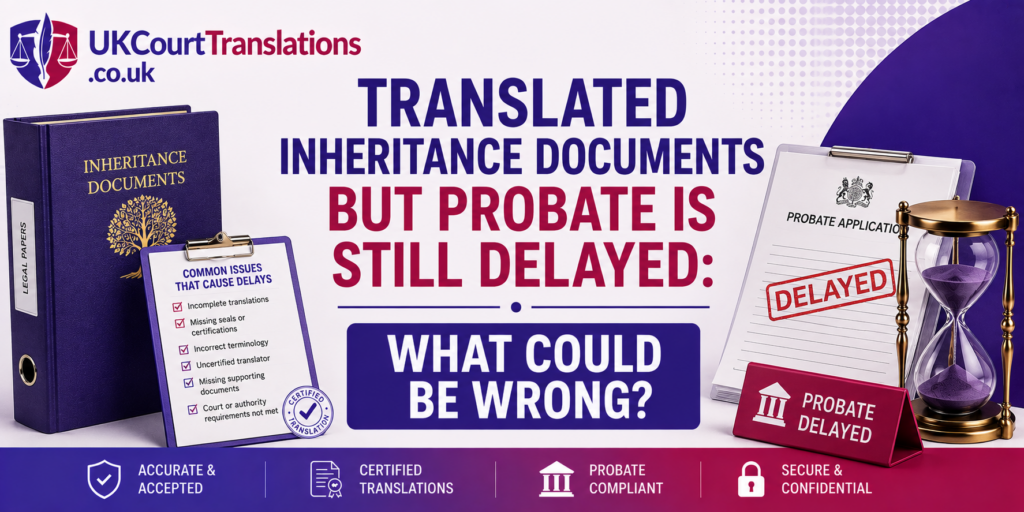
Probate is slow enough without paperwork coming back. Almost every delay we see would have cost nothing to prevent — and most of it was decided before anyone opened the file, in the choice of who did the work.
Our specialists have handled wills, succession papers and death certificates from more than a dozen jurisdictions, for executors acting alone and for private client firms running cross-border estates. We are just as willing to tell you a document needs nothing at all.
Send us the will and estate papers for a free review with your application deadline attached, and we will confirm the scope, the certification required and a fixed cost before anything begins.