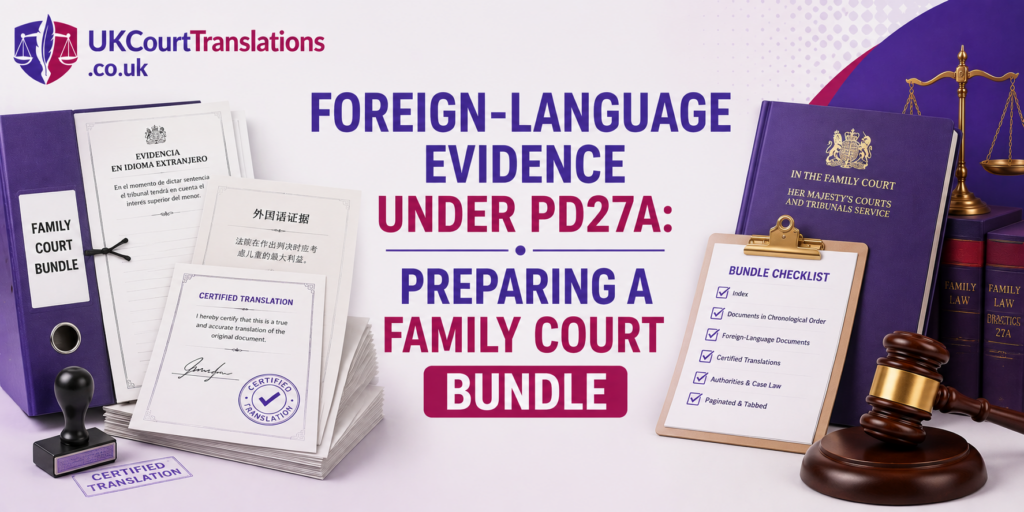
Family law solicitors insist on certified translations because the court must be able to rely on a foreign-language document as evidence, and a certified translation carries a signed certificate of accuracy identifying who translated it and their competence to do so. Without that, the document can be challenged, excluded, or cause a hearing to be adjourned — and under the rewritten Practice Direction 27A, in force since 2 March 2026, bundle standards are stricter than ever.
We prepare foreign-language evidence for family practices across England and Wales, and the same conversation comes up every week: a fee earner has a Polish court order, an Urdu nikahnama or Romanian bank statements, and a hearing three weeks away. At UK Court Translations, our specialists work to the standard a judge will actually test, not the standard that merely looks tidy. Here is what our editors have learned about where these files go wrong, and what a defensible translation looks like in practice.
What “Certified” Actually Buys You In Court
A certified translation attaches a named, accountable person to the accuracy of the document. That accountability is the whole point — it converts a piece of paper into something the court can weigh as evidence.
The certificate of accuracy should identify the translator, confirm their competence in that language pair, describe the document translated, and be signed and dated. Where accuracy is disputed, that certificate is what allows the translator’s position to be supported by a witness statement or affidavit.
⚠️ Where it breaks down in practice: we regularly review translations that carry a company logo and the word “certified” stamped at the bottom — and nothing else. No named translator, no statement of competence, no signature. If your opponent asks who produced it and on what basis, there is no answer to give.
Worth remembering: certification speaks to accuracy. Notarisation speaks to identity. Legalisation speaks to the origin document. They solve separate problems, and the level required depends on the route your matter is taking — our advice would be to confirm the requirement before commissioning anything.
⚠️ Why The Bilingual Client Cannot Do It
Because a party to the proceedings is not independent, and a translation produced by someone with an interest in the outcome invites exactly the challenge you are trying to avoid.
This comes up constantly. A client speaks fluent Arabic and offers to translate their own police report. A cousin offers to do the Romanian property deeds for free. Both are well meant, and both create risk:
- No independence. The other side can suggest, fairly or not, that helpful passages were emphasised and unhelpful ones softened.
- No accountability. There is nobody who can be asked to stand behind the document under a statement of truth.
- Selective coverage. Non-professionals translate meaning, not documents — stamps, seals, marginal notes and footers get skipped.
- Terminology drift. A foreign order may speak of guardianship or parental authority; rendering that as “custody” can change what the foreign court actually decided.
What we do instead: the entire page is rendered — seals, stamps, case numbers, handwritten judicial notes, and anything illegible flagged as illegible rather than guessed. That completeness is what our certified legal document translation work is built around.
➔ Where Non-English Documents Show Up Across A Family Caseload
Foreign-language material is no longer confined to international cases. It now appears in routine private law, financial remedy and domestic abuse work.
| **Case type** | **Documents we most often receive** | **Why the translation gets scrutinised** |
| **Financial remedy** | Overseas bank statements, payslips, property deeds and valuations | Form E disclosure must be complete; figures and dates are cross-examined |
| **Private law children** | Foreign custody and contact orders, school and medical records | The court needs to know precisely what rights a foreign order conferred |
| **Divorce and validity** | Foreign marriage and divorce certificates, *nikahnama*, civil registry extracts | Names, dates and issuing authority must match every other document |
| **Domestic abuse** | Police reports, medical notes, messages in another language | Evidence may be contested line by line |
| **Pre-nuptial agreements** | Agreements drafted abroad in the parties’ own language | Weight given to the agreement depends on what it actually says |
The Pd27A Problem Nobody Plans For
Practice Direction 27A was comprehensively rewritten and has been in force since 2 March 2026, with clarifying amendments made later that month. Bundle standards are now tighter, and translations must arrive in a form that fits them.
The practical consequences for anyone assembling a file:
- E-bundles are the default and must be PDF. Word documents are not acceptable, so a translation delivered as an editable file has to be converted and re-checked — usually at the worst moment.
- Pagination discipline. Non-financial-remedy proceedings use Bates numbering; financial remedy uses consecutive Arabic numbering. Translations inserted late force renumbering of everything after them.
- A page ceiling applies. A 350-page limit means original-plus-translation pairs need thinking about early, not the night before.
- Filing deadlines bite. Bundles are due by 11am one working day before the hearing. A translation that lands the afternoon before has already missed the window.
- Searchable text matters. OCR and a hyperlinked index are expected, so scanned images of a translation create work.
✔ What to send us to avoid all of the above
✔ The clearest scan available, all pages, including blank reverse sides
✔ Passport or ID spellings for every name in the file
✔ Your pagination convention and section letters
✔ The hearing date, not just “urgent”
✔ Any earlier translations in the matter, so terminology stays consistent
✔ A note of which documents are likely to be contested
The Exposure When It Goes Wrong
An unreliable translation can cost you an adjournment, an adverse costs argument, and an uncomfortable conversation with your client. It is a professional risk, not just an administrative one.
Solicitors owe duties to the court and to their client, and filing evidence that cannot be stood behind sits badly with both. Where a hearing is lost because material was incomplete or challenged, wasted costs arguments follow, and the firm’s own indemnity position comes into focus. There is also a fairness dimension the courts take seriously — where a litigant in person does not read English, untranslated material undermines equality of arms and the right to know the case they must meet.
Frequently Asked Questions
What Makes A Translation “Certified” In The Uk?
A certified translation carries a signed certificate of accuracy naming the translator, confirming their competence in the language pair, identifying the document, and dated. There is no single government register, so courts and solicitors look to qualified professional translators who can support the certificate by witness statement if challenged.
Can A Client Translate Their Own Documents For The Family Court?
No. A party to the proceedings is not independent, and their translation can be challenged on that basis alone. Even where the client’s language skills are excellent, the court needs an accountable third party behind the accuracy of the document.
Do All Non-English Documents In A Bundle Need Translating?
If you are relying on a document as evidence, the court must be able to read it in full. Partial translation of only the helpful paragraphs invites an argument that context was withheld, so complete translation is the safer approach.
Is Notarisation Required As Well As Certification?
Not usually. Notarisation verifies the identity of the person signing, not the quality of the translation. Whether it is needed depends on the specific route and receiving authority — confirm the requirement before ordering it.
What Happens If A Translation Is Challenged At A Hearing?
The court may require the translator to explain their credentials and method, or direct a fresh translation. A properly certified document with a named, qualified translator behind it is what allows that challenge to be answered rather than conceded.
Build Translation Into The Timetable, Not The Panic
Family practices rarely lose time because a translation was slow — they lose it because it was commissioned late, arrived in the wrong format, or came back too thin to withstand challenge. Over the years we have supported solicitors, paralegals and chambers across England and Wales, and we plan around your listing rather than our own convenience. Send us the documents when the file opens and we will confirm what needs translating, flag anything that will complicate the bundle, and deliver in bundle-ready PDF with your pagination convention applied.
Our translators are qualified legal linguists, our editors check every seal, signature and name spelling, and every file is handled under strict confidentiality and GDPR-compliant practice. If a hearing is already listed, tell us the date when you get in touch and we will work to it. When you’re ready, send us your case documents for a free assessment and let us handle the rest.