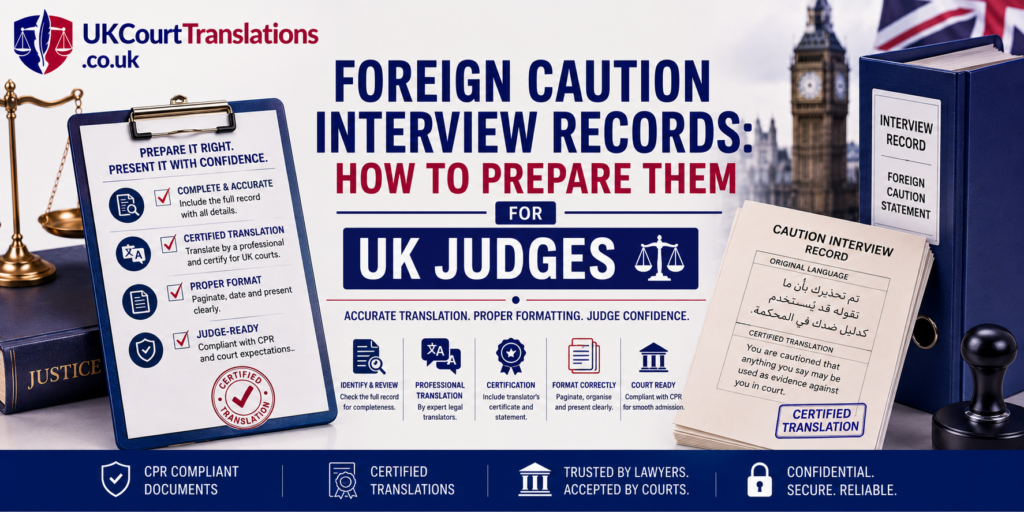
If a foreign caution interview record is being used in UK court proceedings, it should be translated accurately while preserving the original structure, question-and-answer sequence, speaker labels, dates, reference numbers, and other important details. A professionally prepared translation makes it easier for solicitors and legal professionals to review the document clearly and reduces the risk of unnecessary questions about the record.
When a foreign police caution interview becomes part of a UK legal case, accuracy alone isn’t enough. The way the interview is translated and presented can make a significant difference to how easily legal professionals understand the document.
Unlike ordinary document translation, caution interview records often contain a structured conversation between police officers, interviewees, interpreters, and sometimes legal representatives. If that structure changes during translation, the document can become difficult to follow—even when every sentence has been translated correctly.
At UK Court Translations, we’ve spent more than 15 years translating complex legal documents for solicitors, barristers, investigators, and private clients. Over the years, we’ve translated numerous foreign police interviews, witness statements, investigation records, and court documents, and one lesson has remained the same:
A well-formatted legal translation is easier to review, easier to understand, and helps preserve the original meaning of the interview.
In this guide, we’ll explain how foreign caution interview records should be prepared for UK court proceedings and highlight the practical details that matter most during translation.
Why Accurate Formatting Matters in a Foreign Caution Interview Record
Most people focus on whether the words have been translated correctly, but legal professionals also pay close attention to how the information is presented.
A caution interview isn’t written like a normal document. It’s a recorded conversation where every question, answer, pause, and remark may contribute to the overall context of the interview. PACE Code C guidance on interview records also sets out requirements relating to interpretation and translation in police interview contexts. The same care is important when preparing other forms of evidence for criminal proceedings, including audio evidence.
If the original structure disappears during translation, reviewing the interview becomes much harder.
Think of it this way…
✅ A well-prepared interview record allows the reader to:
✔ Following the conversation naturally
✔ Identifying who is speaking at every stage
✔ Understanding questions and answers in the correct order
✔ Locating specific parts of the interview quickly
✔ Comparing the translated version with the original document when required
❌ Poor formatting can create unnecessary confusion
Instead of helping the reader, poor formatting may lead to problems such as:
❌ Questions and answers running together
❌ Different speakers becoming difficult to identify
❌ Paragraphs appearing out of sequence
❌ Important interview notes being overlooked
❌ Extra time spent understanding the document
💡 Expert Insight
A legal translation doesn’t become clearer by rewriting the interview into smoother English. Its job is to reflect the original interview faithfully while keeping it easy to review.
This is why, before translation even begins, we carefully examine how the original interview has been organised so that the translated version follows the same logical structure wherever appropriate.
What Should Never Change in a Foreign Caution Interview Record?
One of the biggest mistakes people make is assuming that only the wording matters.
In reality, many parts of the original interview help explain who said what, when they said it, and how the conversation progressed. These details should remain consistent throughout the translated version.
Our translation checklist includes preserving:
✅ Question and answer sequence
Every question should remain connected to its original answer. Rearranging the conversation can change the flow and make the interview harder to follow.
✅ Speaker labels
Whether the speaker is a police officer, interviewee, interpreter, or another participant, each speaker should remain clearly identified throughout the document.
✅ Dates and times
Interview dates, timestamps, and time references should remain accurate and consistent with the original record.
✅ Reference numbers
Case numbers, exhibit references, document identifiers, and interview references should match the original document exactly.
✅ Page order
Every page should remain in its original order so the translated record follows the same progression as the source document.
✅ Paragraph structure
Where possible, the original layout should be reflected so legal professionals can move between the original and translated versions more easily.
✔ Quick Reference
| Keep Exactly the Same | Why It Matters |
|---|---|
| Speaker labels | Shows who is speaking throughout the interview. |
| Question & answer order | Preserves the natural flow of the conversation. |
| Dates and times | Maintains an accurate timeline. |
| Case reference numbers | Helps identify the correct legal record. |
| Page sequence | Keeps both versions aligned for review. |
Quick Tip: Before sending your documents for translation, check that every page has been included. Even one missing page can interrupt the flow of the interview and leave important context out of the translated record.
Which Parts of a Foreign Caution Interview Record Should Never Be Summarised or Removed?
When translating legal interviews, less isn’t better.
Sometimes people believe that removing repeated questions, shortening long answers, or skipping handwritten notes will make the document easier to read.
For court-related documents, that approach can create unnecessary uncertainty.
Instead, the translation should reflect the original interview as completely and accurately as possible.
These parts should normally remain in the translated record:
✔ Every interview question.
✔ Every recorded answer.
✔ Officer observations included in the original document.
✔ Interpreter comments where documented.
✔ Handwritten notes that form part of the official record.
✔ Official stamps or annotations appearing on the document.
✔ References to signatures where relevant.
A simple comparison
| ✅ Professional Preparation | ❌ Poor Preparation |
|---|---|
| Every question translated | Selected questions only |
| Complete interview record | Summary of the interview |
| Original notes included where relevant | Handwritten notes ignored |
| Official annotations retained | Stamps or remarks omitted |
| Full conversation preserved | Parts of the discussion removed |
📌 Did You Know?
Even small omissions can make it harder for legal professionals to compare the translated interview with the original document. Preserving the complete record helps maintain clarity throughout the review process.
How Should Different Speakers Be Presented in the Translation?
A foreign caution interview usually involves more than one person. Depending on the investigation, the record may include police officers, the interviewee, an interpreter, legal representatives, or even another investigating officer.
If these speakers aren’t clearly identified in the translated version, the conversation can quickly become confusing.
Instead of making the document easier to read, poor speaker formatting forces legal professionals to stop and work out who is actually speaking.
A professionally formatted translation keeps every speaker clear
For example:
👮 Police Officer
“Where were you on the evening of 14 March?”
👤 Interviewee
“I was at my brother’s house.”
🗣 Interpreter
“The interviewee has asked for the question to be repeated.”
This simple structure allows the conversation to flow naturally while remaining faithful to the original interview.
✔ Good speaker formatting should always:
- Keep each speaker separate.
- Clearly identify every participant throughout the interview.
- Preserve the original order of the conversation.
- Make questions and answers easy to distinguish.
- Remain consistent from the first page to the last.
💡 Expert Tip
Consistent speaker identification helps solicitors compare the translated interview with the original record much more efficiently, especially in lengthy investigations.
How We Prepare Foreign Caution Interview Records for UK Court Proceedings
After working with foreign police interviews and legal documents for more than 15 years, we’ve learnt that quality comes from following a consistent process—not rushing the translation.
Every interview record is reviewed carefully before translation begins.
Our preparation process
📄 Step 1 – Review the Original Record
We examine the interview to understand:
✔ Document structure
✔ Number of speakers
✔ Interview sequence
✔ Handwritten notes
✔ Official markings
✔ Readability of every page
This helps us identify anything that needs attention before translation starts.
⬇️
🌍 Step 2 – Specialist Legal Translation
The interview is translated by legal linguists familiar with police interviews and court documentation.
Our focus isn’t simply translating sentences—it’s preserving the meaning, terminology, and structure of the original interview.
⬇️
📑 Step 3 – Formatting Review
Once translated, we carefully check that:
- Speaker labels remain consistent.
- Questions and answers follow the original order.
- Dates, times, and reference numbers match the source document.
- Formatting remains clear throughout.
⬇️
🔍 Step 4 – Independent Quality Check
A second review helps identify any inconsistencies before the translation is finalised.
We carefully verify:
✔ Names
✔ Dates
✔ Numbers
✔ Legal terminology
✔ Formatting consistency
✔ Overall readability
⬇️
📜 Step 5 – Certification & Secure Delivery
Where certification is required, we provide the appropriate certification alongside the completed translation before securely delivering the documents.
📌 Why This Matters
Following the same structured process for every project helps us deliver translations that are accurate, consistent, and easier for legal professionals to review.
Common Formatting Mistakes in Foreign Caution Interview Records
Many translation problems don’t happen because of language.
They happen because the document has been formatted poorly.
Fortunately, most of these issues are easy to avoid.
Watch out for these common mistakes
❌ Different speakers mixed into one paragraph
❌ Questions and answers placed in the wrong order
❌ Missing page numbers
❌ Inconsistent spelling of names
❌ Cropped scans hiding stamps or handwritten notes
❌ Inconsistent formatting between pages
❌ Official annotations omitted
A quick comparison
| ✅ Professional Preparation | ❌ Avoid These Mistakes |
|---|---|
| Every speaker clearly identified | Speakers mixed together |
| Original sequence maintained | Questions moved around |
| Consistent formatting throughout | Layout changes between pages |
| Complete document translated | Missing pages or sections |
| Original annotations reflected where appropriate | Official notes left out |
Quick Check:
Before approving a translated interview, compare a few pages with the original document. Speaker labels, page order, dates, and reference numbers should remain consistent throughout.
Before You Submit Your Foreign Caution Interview Record: A Final Checklist
Before sending your translated interview to your solicitor or legal team, spend a few minutes checking the essentials.
✔ Submission Checklist
- Every page of the original interview
- Page order matching the original document
- Clear identification of all speakers
- Questions and answers in the correct sequence
- Consistent names, dates, and reference numbers
- Relevant handwritten notes and official annotations
- A clear, complete and easy-to-follow translation
- Certification where required for your legal matter
Save This Checklist:
A final review before submission can help identify small issues that are much easier to correct before the documents are shared with your legal team.
Frequently Asked Questions
Can I change the layout of a foreign caution interview before translation?
It’s generally best to provide the interview in its original format. Changing the layout beforehand can make it more difficult to preserve the original structure during translation.
Should handwritten police notes also be translated?
If handwritten notes form part of the official interview record or provide important context, they should normally be reflected in the translation where they are legible and relevant.
Do timestamps need to remain in the translated version?
Yes. Where timestamps appear in the original interview record, keeping them consistent helps preserve the timeline of the conversation and makes cross-referencing much easier.
Can interview questions be shortened to make the document easier to read?
For legal documents, it’s generally better to preserve the complete interview rather than shortening questions or answers. Maintaining the original flow helps ensure the translated record reflects the source document accurately.
Can I submit only selected pages for translation?
If only certain pages are relevant to your case, your solicitor may advise which documents are required. However, removing pages without legal guidance may also remove important context from the interview.
Need a Foreign Caution Interview Record Professionally Prepared?
When a foreign police caution interview forms part of a UK legal case, accuracy, consistency, and presentation all matter. A professionally prepared translation helps legal professionals review the interview more efficiently while preserving the structure and meaning of the original record.
At UK Court Translations, we’ve spent more than 15 years translating foreign police interviews, witness statements, investigation records, and other legal documents for solicitors, barristers, businesses, and private clients across the UK.
Whether you need a single interview record or a complete bundle of legal documents, our experienced team is ready to help.
📩 Get a Free Quote Today
Simply send us a clear copy of your documents through our online enquiry form. We’ll review your files, explain the most suitable translation option for your legal matter, and provide a fast, no-obligation quotation—helping you move forward with confidence.